How to Build Your Credibility Through Third-Party Validation
Mar 18, 2026
There's a particular kind of credibility that's hard to manufacture: the kind that comes from other people saying you're worth paying attention to.
Being quoted in a publication, interviewed on a podcast, invited to speak at a conference, or recognised with an award. These carry weight precisely because you didn't give them to yourself. They're borrowed credibility, and they compound in ways that self-promotion simply can't.
The challenge is that most experts know this matters, but struggle to make it happen consistently. The opportunities exist. The intention is there. But somehow, "find speaking gigs" and "respond to media requests" stay on the to-do list, rolling over week after week, month after month.
This piece is about how to actually build that credibility: what to pursue, how to evaluate it, and why most people get stuck. And then, how we've systematised the whole thing so the work gets done.
Part 1: The Credibility Playbook
Why Third-Party Validation Compounds
When someone else features you, quotes you, or awards you, three things happen that don't happen with self-promotion:
It's more believable. Editorial judgment carries implicit endorsement. A journalist choosing to quote you, a podcast host choosing to feature you, a conference choosing to platform you. These are signals that someone with no stake in your success thought you were worth including.
It's more shareable. It's awkward to post "I'm an expert in X." It's easy to share "I was interviewed by [Publication] about X." Third-party validation gives you permission to talk about yourself by talking about what others said.
It creates backlinks and SEO value. A mention in a high-domain-authority publication isn't just a credibility signal to humans. It's a credibility signal to search engines. Those backlinks compound over time, boosting your discoverability.
The compounding effect is real: one podcast appearance leads to another host finding you; one byline leads to a journalist adding you to their source list; one award makes the next nomination easier to win. But you have to get the flywheel moving first.
The Five Types of Opportunities Worth Pursuing
Not all visibility is created equal. These are the categories that reliably build expert credibility:
1. Conference Speaking
Standing on a stage (physical or virtual) positions you as an authority. The audience assumes you were vetted. The recording or summary becomes evergreen content. And the other speakers become your peer group by association.
2. Podcast Guesting
Podcasts offer long-form exposure to a host's established audience. Unlike a written quote, listeners hear your voice, your thinking process, your personality. It's intimate in a way that builds trust quickly.
3. Media and Press
Being quoted as an expert source, publishing a guest article, or appearing in a journalist's story. These carry the implicit endorsement of editorial selection. The publication's credibility transfers to you.
4. Awards and Recognition
Industry awards, "top voices" lists, professional accolades. These are social proof condensed into a badge. They're shorthand for "this person has been independently evaluated and found worthy."
5. Expert Commentary
When news breaks in your field and a journalist needs a knowledgeable voice, being that voice is high-leverage visibility. It positions you as the go-to expert when the topic is live and attention is high.
Each of these creates artifacts you can reference later: a speaker bio, a media page, a LinkedIn feature, an award logo. The credibility accumulates.
What "Right" Actually Means
More opportunities isn't the goal. The right opportunities is.
Here's how to evaluate whether something is worth pursuing:
Topic fit. Does this align with the expertise you want to be known for? Saying yes to off-topic requests dilutes your positioning.
Audience quality. Are these the people you're trying to reach? A smaller, highly relevant audience beats a large, generic one.
Credibility signals. Is this earned media, or pay-to-play? Who else has been featured (are you in good company)? What's the domain authority? Will the backlink actually help your site?
Live deadline. Can you realistically respond in time? An opportunity you miss is worse than one you never saw, because you've spent cognitive energy for nothing.
Doable format. Does this require jumping through hoops, or can you respond with content and thinking you already have? The best opportunities leverage existing IP, not demand new work.
When an opportunity meets all five criteria, it's worth acting on immediately. When it meets three or four, it's worth considering. Fewer than that, and you're probably better off waiting for a stronger match.
Why Most Experts Never Act on These
The problem isn't lack of opportunities. It's cognitive load.
We signed up for HARO. We subscribed to SourceBottle. We bookmarked conference CFP pages and set calendar reminders to check them. We had good intentions.
But the actual workflow looked like this: open the email, skim dozens of irrelevant queries, try to remember which topics we'd decided were worth pursuing, wonder if the deadline had already passed, get distracted by something urgent, close the tab. Repeat the following week, with a faint sense of guilt.
The sifting cost is pure cognitive energy. And cognitive energy is precisely what's in short supply when you're running a business, serving clients, and creating content.
We've watched this happen with valuable pieces of IP (fresh, newsworthy content that would have been perfect for publications and podcast guesting) going massively under-leveraged because we couldn't get into gear fast enough. The window closes. The moment passes. And the perpetual to-do list rolls over once more.
Bottom line? It's a systems problem. And systems problems need systems solutions.
Part 2: How We've Systematised It
The Feed Concept
The breakthrough isn't "more sources." It's less noise.
What we needed wasn't another newsletter or another tab to check.
We needed something that would surface the handful of opportunities actually worth considering (matched to specific expertise, with live deadlines, at credibility levels worth being associated with).
That's the core insight behind Opportunities, the feature we've built into Virtually Myself®: an AI-powered daily feed that scans the web for speaking gigs, podcast guesting opportunities, media requests, awards, tenders, and more, then scores each one against your profile and existing content.
The shift is subtle but transformative. Instead of spending cognitive energy finding opportunities, you spend it choosing and acting. The sifting is done for you. What remains is a shortlist you can actually engage with.
How It Works in Practice
Every day, the system scans across multiple categories:
- Conference Speaking (open calls for speakers matched to your expertise)
- Podcast Guesting (shows seeking guests on topics you know deeply)
- Media Requests (journalist queries and publications accepting guest articles)
- Awards & Recognition (industry awards, thought leader lists, professional accolades)
- Tenders & RFPs (open requests for consulting and advisory services)
- News Alerts (developments where you could offer expert commentary)
- Mentions & Reputation (where you or your brand are being discussed)
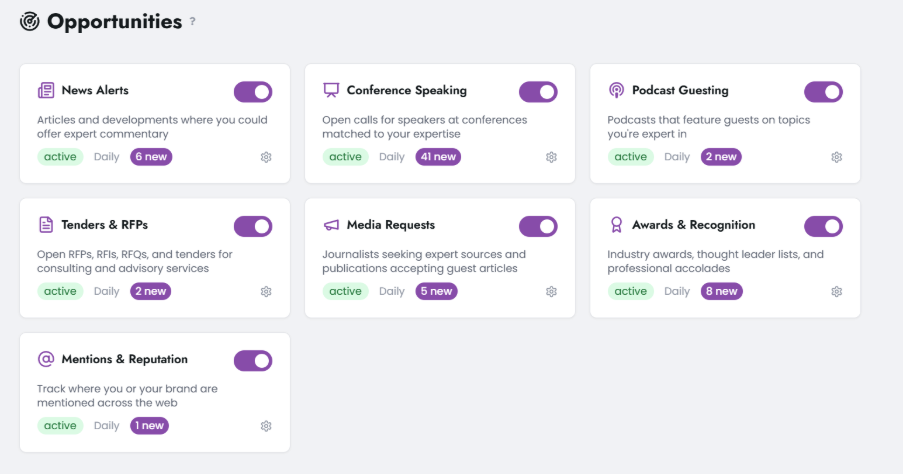
Each opportunity is scored 0–100% based on how well it matches your profile.
Green badges (60%+) indicate strong matches worth a close look.
Yellow (40–59%) suggests moderate relevance.
Grey means weaker fit but included for reference.
The workflow is deliberately simple: New → Viewed → Saved → Acted → Dismissed.
New opportunities appear automatically after each daily scan. Mark what you've seen, bookmark what you want to return to, confirm when you've responded, dismiss what's not relevant.
For media requests, there's a slight twist. Instead of scraping the web, the system parses journalist query emails you forward (HARO digests, SourceBottle callouts, MentionMatch requests). They're automatically split into individual opportunities, scored against your expertise, and added to your feed with deadline and response details attached.
The Compound Effect
Here's what changes when this is running:
The cognitive load drops. The perpetual to-do item becomes a five-minute daily scan. Opportunities that would have been missed get actioned. Fresh content gets leveraged while it's still timely.
And because you've got the platform at your disposal to help you respond quickly (drafting pitches, preparing talking points, pulling relevant content) the gap between "this looks good" and "done" shrinks dramatically.
We built this because we kept seeing the same pattern: brilliant people with valuable expertise, stuck in a rollover loop that was costing them visibility and credibility. The opportunity feed isn't about finding more. It's about surfacing less (the right less) so you can finally act.
Third-party validation is one of the most powerful credibility tools available to experts. But only if you can actually capture it. The difference between experts who accumulate this kind of credibility and those who don't isn't talent or even effort. It's whether they have a system that turns intention into action before the window closes.
The Opportunities feature is available now in Virtually Myself®.
If you'd like to see it in action, join us at an upcoming demo where you can see it live and ask us your questions in real time.